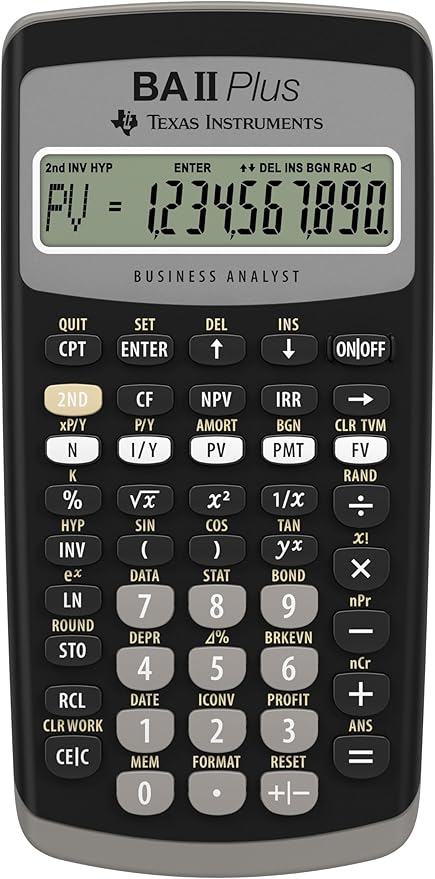
TI BA II Plus vs BA II Plus Professional: Which Should You Buy for the CFA Exam?
CFA Institute authorizes both TI calculators, and TI says they are nearly identical apart from five worksheet features. Here is what the Professional adds, the P/Y default difference, and which model suits which candidate.
TI BA II Plus vs BA II Plus Professional: which should I buy for the CFA exam?
For most CFA candidates the standard BA II Plus is the better buy: CFA Institute authorizes both models, and Texas Instruments says the two are "nearly identical in terms of functionality" apart from five worksheet features. Choose the BA II Plus Professional if you want net future value, payback, modified IRR and modified duration as one-key outputs, or you prefer its heavier, more premium build. Replying to a reader, the CFA-prep site 300Hours put it plainly: the regular model "is more than enough for all 3 levels".
This comparison draws on Texas Instruments' support articles, CFA Institute's calculator policy and two named CFA-prep guides, 300Hours and Kaplan Schweser, rather than first-hand use. It is general information about two calculators, not financial advice, and each detail was checked October 2026.
What CFA Institute allows on exam day
CFA Institute's calculator policy (updated 12 Jan 2026, checked October 2026) names both TI models in a single line: "Only two calculator models are authorized for use during CFA Program exams: Texas Instruments BA II Plus (including BA II Plus Professional) Hewlett Packard 12C (including the HP 12C Platinum, 12C Platinum 25th anniversary edition, 12C 30th anniversary edition, and HP 12C Prestige)." The Professional is not a gray area; it sits inside the same parenthesis as the base model.
The rest of the policy sets four practical rules:
- Bring your own. "You may not borrow a calculator from the test center," and you may not borrow from or share with another candidate during the exam.
- Expect an inspection. "Your calculator will be inspected prior to the start of the exam," and use or possession of an unauthorized calculator "will result in your exam results being voided."
- Spares are fine, manuals are not. "Calculator covers, keystroke cards, and loose batteries are permitted in the testing room; instruction manuals are not."
- A screwdriver is allowed for one model. "You may keep a small screwdriver with you if necessary to replace batteries in the BA II Plus".
That last rule points to a real hardware difference. 300Hours' battery instructions for the basic model call for "a small Phillips screwdriver (00 size)", while on the BA II Plus Professional "the back cover easily slides out without the need for screwdrivers." Both run on the same coin cell: TI's battery article says "Old batteries need to be replaced with Eveready CR2032, Duracell DL2032, or the equivalent." 300Hours also suggests that if a battery needs changing, you do it "a week or so before the exam".
The five differences, straight from TI
Texas Instruments' support article on the differences between the two calculators is the primary source for this question, and it is unambiguous: "The BA II PLUS and BA II PLUS PROFESSIONAL are nearly identical in terms of functionality, with the exception of five key features." The Professional, TI says, "includes four additional Cash Flow worksheet variables and one Bond worksheet variable that are not included on the BA II PLUS."
| Extra on the Professional | Worksheet | TI's label | What it gives you |
|---|---|---|---|
| Net future value (NFV) | Cash Flow | Compute-only | The future value of an uneven cash-flow series |
| Payback (PB) | Cash Flow | Compute-only | How long cumulative cash flows take to repay the outlay |
| Discounted payback (DPB) | Cash Flow | Compute-only | The same test run on discounted cash flows |
| Reinvestment rate (RI) | Cash Flow | Enter-only | The reinvestment rate the modified IRR assumes |
| Modified internal rate of return (MOD) | Cash Flow | Compute-only | A modified IRR that assumes reinvestment at the RI rate |
| Modified duration (DUR) | Bond | Auto-compute | A bond's price sensitivity to a change in yield |
TI's list has six entries for its "five key features"; the odd one out is the reinvestment rate, an enter-only input that feeds the modified IRR rather than an output of its own. Everything outside that list, from time value of money and amortization to NPV, IRR and bond pricing, is shared under TI's "nearly identical" wording. That is also why 300Hours can say its keystroke tips "apply to both BA II Plus & BA II Plus Professional calculator models."
The P/Y default: the difference that catches people out
The less-advertised difference is a factory setting. TI's support article explains: "The P/Y and C/Y default setting was changed from 12 on the BA II PLUS to 1 on the BA II PLUS PROFESSIONAL at the request of finance professors that were consulted during the development of the new calculator." The same article tells you to "Set P/Y to 1 for annual payments or 12 for monthly payments", so out of the box the base model assumes monthly periods and the Professional assumes annual ones.
Three details decide how much that matters in practice:
- The setting sticks until a reset. TI says a changed setting stays put "unless the calculator is reset or [2ND] [CLR WORK] is pressed while on the P/Y setting screen", and that clearing the TVM worksheet leaves "the P/Y C/Y setting" unchanged.
- A battery swap counts as a reset. 300Hours notes that "replacing the battery has the same effect as resetting the calculator", so the factory default comes back with a new cell.
- Prep providers lean toward 1. Kaplan Schweser's guide says the calculator "defaults to 12 periods per year (monthly)", which is the base model's default per TI, and that "in the CFA curriculum, it is much safer to set this to 1 and manually adjust your N and I/Y values."
So the Professional ships with the setting Schweser recommends, a small convenience, while a base-model owner sets it once and re-checks it after any reset or battery change. On either calculator, set P/Y and C/Y deliberately instead of trusting whatever the screen shows.
Weight, buttons and the cover
On feel, the two prep providers disagree. 300Hours recommends the basic model: its author writes that the Professional "certainly looks better and feels more premium" but that the effort to make it premium "(weight and button press) did the calculator a disservice without extra benefits". The site's list of drawbacks opens with "More expensive" and "Nearly 50% heavier than BA II Plus (including its cover)", and adds that "The Professional version doesn't come with a cover by the way." It also finds the Professional's keys "harder to press and not as responsive when keying in data", and notes that they "are all the same colour, in an effort to look sleek."
Kaplan Schweser takes the opposite view: "We highly recommend the TI BA II Plus Professional for its additional functionality and ease of use." When two established prep providers reach opposite verdicts, the fair reading is that the choice turns on comfort and convenience rather than capability. Wikipedia's entry dates the base BA II Plus to 1991 and describes the Professional, introduced in 2004, as "an upgrade to the base model".
Does the CFA curriculum need NFV, payback or modified duration?
The extra variables are shortcuts, not new abilities. Schweser's guide files NFV under "TI BA II Plus Professional Only" and explains where it lives: after entering uneven cash flows and computing NPV, you "scroll down one more time past the NPV result" to reach it. 300Hours is less impressed, saying the NFV function "only applies very select cases of NPV, and can be done via NPV yourself anyway", and that the extras overall "don't save much time, nor is tested often."
Payback, discounted payback and modified duration are the same kind of shortcut. Each can be built from figures the base model already produces: cumulative cash flows for payback, discounted cash flows for discounted payback, and, for a bond, a duration calculated from its cash flows. On the Professional, each becomes a single compute key.
Popularity matters more than any of these. Schweser calls the BA II Plus family "the most popular choice due to its user-friendly interface", and 300Hours says the BA II Plus "is used by most CFA exam candidates". The practical upshot is that most keystroke help in prep notes, videos and study groups assumes a TI, and it works on both TI models.
Price and where to buy
This page does not quote a price for either calculator. Texas Instruments' product pages show no price in readable form, and Amazon, where these links go, sets its own. 300Hours lists "More expensive" first among the Professional's drawbacks, so expect it to cost more, and weigh that gap against the six variables in the table above.
- Standard BA II Plus: Check price on Amazon
- BA II Plus Professional: Check price on Amazon
The site's TI BA II Plus review covers the base model in more depth; treat any price it mentions as dated.
The HP 12C Platinum: the other authorized option
If you already own and like an HP 12C, it is equally legal: CFA Institute's list covers "the HP 12C Platinum, 12C Platinum 25th anniversary edition, 12C 30th anniversary edition, and HP 12C Prestige." The trade-off is support rather than legality, because with the TI the more common choice, most keystroke help will assume a TI. Check price on Amazon if the HP is the calculator you already think in. Our roundup of financial calculators for money goals looks at the same machines from a personal-finance angle rather than an exam one, and you can see our full shortlist of the site's head-to-head comparisons.
Side by side at a glance
| BA II Plus | BA II Plus Professional | |
|---|---|---|
| CFA exam status (CFA Institute) | Authorized | Authorized, same policy line |
| NFV, payback, discounted payback, modified IRR, modified duration (TI) | No | Yes |
| Factory P/Y and C/Y setting (TI) | 12 | 1 |
| Battery (TI) | CR2032-type lithium cell, about 1500 hours | Same |
| Battery access (300Hours) | Small Phillips screwdriver | Back cover slides out |
| Comes with a cover (300Hours) | Yes | No |
| Weight (300Hours) | Lighter | Nearly 50% heavier |
| Introduced (Wikipedia) | 1991 | 2004 |
Which one to buy: three candidate profiles
A Level I candidate buying one calculator for the whole program. The base BA II Plus is the model 300Hours recommends, and TI's own list shows it lacks only five shortcut features. Put a spare battery and a keystroke card in your exam bag; the policy allows both.
A candidate who expects to use the calculator at work afterwards. NFV, payback, discounted payback and modified IRR are capital-budgeting measures, so if your job will involve them, the Professional's one-key outputs have more use after the exam than during it.
Someone replacing a calculator shortly before the exam. Buy the model you studied on. The P/Y default and the different key feel are small differences, but exam week is not the time to discover them.
FAQ
Is the BA II Plus Professional allowed in the CFA exam?
Yes. CFA Institute's calculator policy names "Texas Instruments BA II Plus (including BA II Plus Professional)" as one of only two authorized model families (checked October 2026). Calculators are inspected before the exam starts, and an unauthorized one voids your results.
Will I be at a disadvantage with the basic BA II Plus?
Not on the evidence available. TI describes the two as nearly identical apart from five worksheet features, and 300Hours says NFV can be done via NPV anyway. The prep providers split on preference, with 300Hours recommending the basic model and Kaplan Schweser the Professional, which points to comfort rather than capability.
Why does P/Y show 12 on one calculator and 1 on the other?
Because TI changed the factory default: P/Y and C/Y are 12 on the BA II Plus and 1 on the BA II Plus Professional, a change TI says finance professors requested. A reset or a battery change brings the default back, so check it at the start of each study session on either model.
Can I bring spare batteries and a screwdriver?
Yes. CFA Institute permits calculator covers, keystroke cards and loose batteries in the testing room and lets you keep a small screwdriver to replace batteries in the BA II Plus. Instruction manuals are not permitted.
Is the HP 12C a better choice than either TI?
Only if you already use one. The policy lists the HP 12C with its Platinum, anniversary and Prestige editions, so it is just as legal, but the TI is the more common choice among candidates, which makes study help easier to find.
Sources
- Solution 18069: Differences Between the BA II PLUS and the BA II PLUS PROFESSIONAL — Texas Instruments (checked October 2026)
- Solution 11262: Different P/Y and C/Y Settings on the BA II PLUS PROFESSIONAL and BA II PLUS — Texas Instruments (checked October 2026)
- Solution 11263: Expected Battery Life of the BA II PLUS and BA II PLUS PROFESSIONAL — Texas Instruments (checked October 2026)
- CFA Exam Calculator Policy — CFA Institute (checked October 2026)
- How to Use the TI BA II Plus? 2026 Settings and Tips Guide — 300Hours (checked October 2026)
- CFA Exam Calculator: TI BAII Plus Basics for the CFA Exam — Kaplan Schweser (checked October 2026)
- Texas Instruments Business Analyst — Wikipedia (checked October 2026)
Zero-Based Budget Spreadsheet
Free Google Sheets template for zero-based budgeting. Tracks income, fixed expenses, variable spending, and savings goals with automated monthly summaries.
Trusted by 5,000+ users
Instant download. No spam. Unsubscribe anytime.
Affiliate Disclosure